For illustrated talks on natural history and history see www.peterlovetttalks.co.uk

For illustrated talks on natural history and history click here for www.peterlovetttalks.co.uk

Tuesday, 15 June 2010

Fly orchids and the President of The Ramblers meets Sussexrambler.

Last Sunday's walk was great, finding six orchid species.  Yet I was dissatisfied with my pictures of Fly orchids and I went back today to take more pictures with a monopod and some sheets of polystyrene to reflect more light.  I was not alone.  The BBC Secret Britain team were there with David Lang, the UK's authority on orchids.  The National Trust ranger was kind enough to show me this specimen.  And Julia was kind enough to have her picture taken with me!
 
This is a much better shot. 
And here it is with a digger wasp.  Click on any picture to expand it.  David Lang told me that he had not yet taken a photo with this pollinating wasp and went back to try to get one.  I hope that he succeeded.
The male wasps, Argogorytes mystaceus are evidently fooled by pheremones and attempt to copulate with the flower, in the process removing the pollinia.  The female wasps emerge some days later than the males, but once the females are on the wing the males realise the error of their ways and leave the orchids alone.
Source; "Wild Orchids of Sussex" by David Lang, ISBN 0-9533493-3-0.
What a great day.  And I am really pleased to have got these pictures.  I am grateful too to Bernard Rickard, whose advice on the Leki monopod walking pole contributed to the clarity of these shots.  With the monopod, I suspect that the focus is greatly improved. 
In the conversation with David Lang, I mentioned that last year I found a "double orchid flower", which is included above.  David said that this was very rare and that he had only ever seen one -- on Beachy Head.
Well here it is.  Extremely rare.  And you saw it here first.
I rambled on hoping to stumble upon a Man orchid to no avail, but did take other pictures.
UPDATE:  In 2017 eleven orchid species were recorded on the hill thanks to conservation work by the Friends of Wolstonbury.
Wild thyme was flowering on the ant hills, each of which hosts an estimated 100,000 ants.
Green woodpeckers eat ants.
So you would expect to find Green Woodpecker droppings....
...which, if you break them open, contain the empty exoskeletons of ants!
Common it might be, yet this white form of the Common Spotted-orchid stood out.
Fragrant orchids are abundant on the western slopes, together with the Common spotted ones and vetch.
Butterflies are difficult to photograph and for me, difficult to identify.  This is probably a female "blue butterfly", but which one I can't tell.
Above is the rare Silver-spotted Skipper.  Please see http://butterfly-conservation.org/872-790/silver-spotted-skipper.html  for more information.

St John's Wort has antidepressant effects.

 Stay clear of the Nightshade Bittersweet, whose eventual red berries are poisonous.

Tuesday, 8 June 2010

Lindfield Circular Walk with Common Spotted-orchids and wild roses.

This 7.1 miles walk, lead by Tony was from the Mid Sussex Ramblers' programme, starting from the lovely village of Lindfield.
Lindfield pond was home to a Mallard family.
Click on any picture to expand it.
 The Toll House is a reminder of past times.
One reason behind the multitude of lanes and paths in Sussex was landowners establishing their own routes across their own land to move goods and livestock avoiding the toll gates on the main routes.
One of Lindfield's fine houses.
Crossing the river Ouse we passed this Guelder Rose, Viburnum opulus a shrub which will have round red berries later.

Not everyone gets excited over a dung pit.  Yet this is what badgers do - dig a pit and poo in it.  So this is a sign of recent badger activity.  Why don't we just inoculate cattle against TB like we do ourselves and leave the badgers alone?
At Ardingly reservoir and within say 30m of a car park for disabled persons is this exquisite little meadow, which this day was full of Common Spotted-orchids.  What a joy to see, the more so as we saw none others on this day.
Heading south on the High Weald Landscape Trail, the hedgerow was resplendent with the second rose of the day...
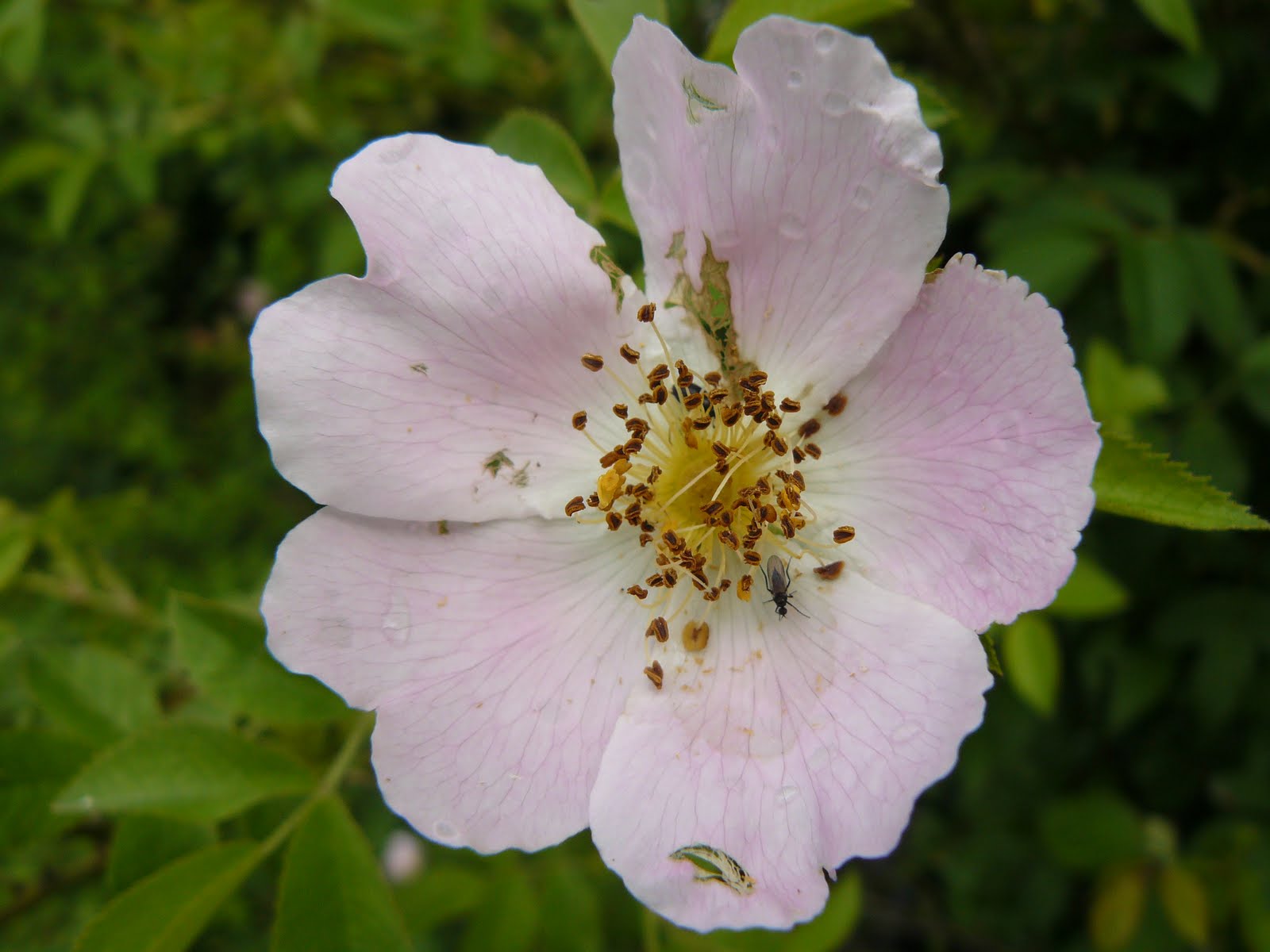
the Dog Rose, Rosa canina.
 Passing a recent clearing in the forest, we enjoyed a fine display of Red Campion and Foxgloves.  The insect above, resting on a foxglove caught my eye.  It did not fly off when I took this picture and now you can see why.  It seems to have lost its left wing.  What fine antennae!
Further up the glade is a fine display of Wood Spurge.
Professor William Coleman was the back-marker on this day and pointed out the Figwort below.
Thanks Tony and William for another fine walk from the Mid Sussex Ramblers.

Wednesday, 2 June 2010

Wolstonbury Hill, Twayblades and more

 On this afternoon I left the Red Campion and Cow Parsley at the foot of Wolstonbury Hill to look for orchids.  Click on any picture to expand it.
I had expected to find lots of Common spotted Orchids, yet spotted none yet in this location.
There was a lot more orchids to see though, namely Common Twayblades to make this a wonderful afternoon stroll.

 The northern slope of the hill is steep, with shady deciduous woodland.  Wild garlic pervades the air having now gone to seed.
 The view towards Jack and Jill windmills on Clayton hill.


This looks like "Hound's tongue".
 There were dozens of these Common Blues on this sudden hot (21C) day.
 According to Wikopedia, Sainfoin is derived from Old French sain foin ("healthy hay") as it is a good fodder crop.
It is certainly very beautiful.

I haven't had time to figure what this is, but it is an intricate bud and possibly a Knapweed about to burst into flower.
Click on any picture to expand it.
This Common Twayblade derives its name from old Norse meaning two leaves.
They are indeed, common on the hill at this time and are fascinating plants; the flowers look like little people.


Milkwort?
  Below, looks like an Early purple Orchid, which is past its best.
There are many more orchid species yet to emerge promising more lovely walks to come.

Blog Archive