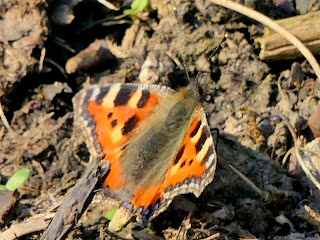


The first Brimstone sighting of the year in my garden but not the first in Sussex. That was yesterday.
On the top of the High Weald ridge that is Ardingly showground the wind was bitingly cold this Wednesday morning on the 9th March 2022 as


More info' at https://en.wikipedia.org/wiki/Lathraea_clandestina and also https://sussexrambler.blogspot.com/search?q=purple+toothwort
Descending the valley, care was taken to keep to the public footpath along the hedge line as it passes around and not through Tillinghurst farmyard. Purple toothwort was seen and later the post-medieval breached coffer dam and former hammer pond up stream from Westwood Lake at Wakehurst place.

An excellent display board, above by Kew Gardens at Westwood Lake explains the history of iron making here with beautiful graphics.


The group near the beginning with 180 metres of ascent and descent to come
Early purple orchids, pyramidal orchids, man orchids and rare, tiny fly orchids flower much later in the year than the 27th February 2022, when Haywards Heath nature walks group embarked on a four miles circular walk to see these rare plants. Some native orchids produce their leaf rosettes months before flowering. Although man orchids remained elusive on this day, the other three species’ rosettes were found by following the bridleways and steep footpaths of the National Trust’s, Wolstonbury Hill in the Sussex Downs, north of Brighton.

Joyous
walkers spot several fly and early purple orchid rosettes.


A former rifle range from 1860 was crossed. It was set up after the Crimean war
(1853-1856) in which Russia lost to an alliance of France, the Ottoman Empire,
the United Kingdom and Piedmont-Sardinia.
Then, climbing to a northern slope it was Alison John, the leader of
Haywards Heath u3a natural history group, who spotted a group of pyramidal
orchids, where dense dogwood had been cleared over the winter.

Alison
was first to spot pyramidal orchid rosettes.

Pyramidal
orchid rosettes.


I was highly pleased with the results, as with eleven pairs of eyes scanning the route plants were found that inevitably might escape a lone naturalist.
One gains so much from u3a groups, especially the
physical and mental health benefits from walking with amiable companions.
At https://www.haywardsheathu3a.org.uk/ you can see the vast range of interests open to u3a members, including being able to join nature walks like this one.
What a bargain at just £10 / year.
Although three fly orchids were found, many more had been trampled by walkers on the bank
alongside the bridleway.
Responsible walkers respect the request at the
National Trust, Nymans gardens in Sussex;


