For illustrated talks on natural history and history see www.peterlovetttalks.co.uk

For illustrated talks on natural history and history click here for www.peterlovetttalks.co.uk

Wednesday, 8 June 2016

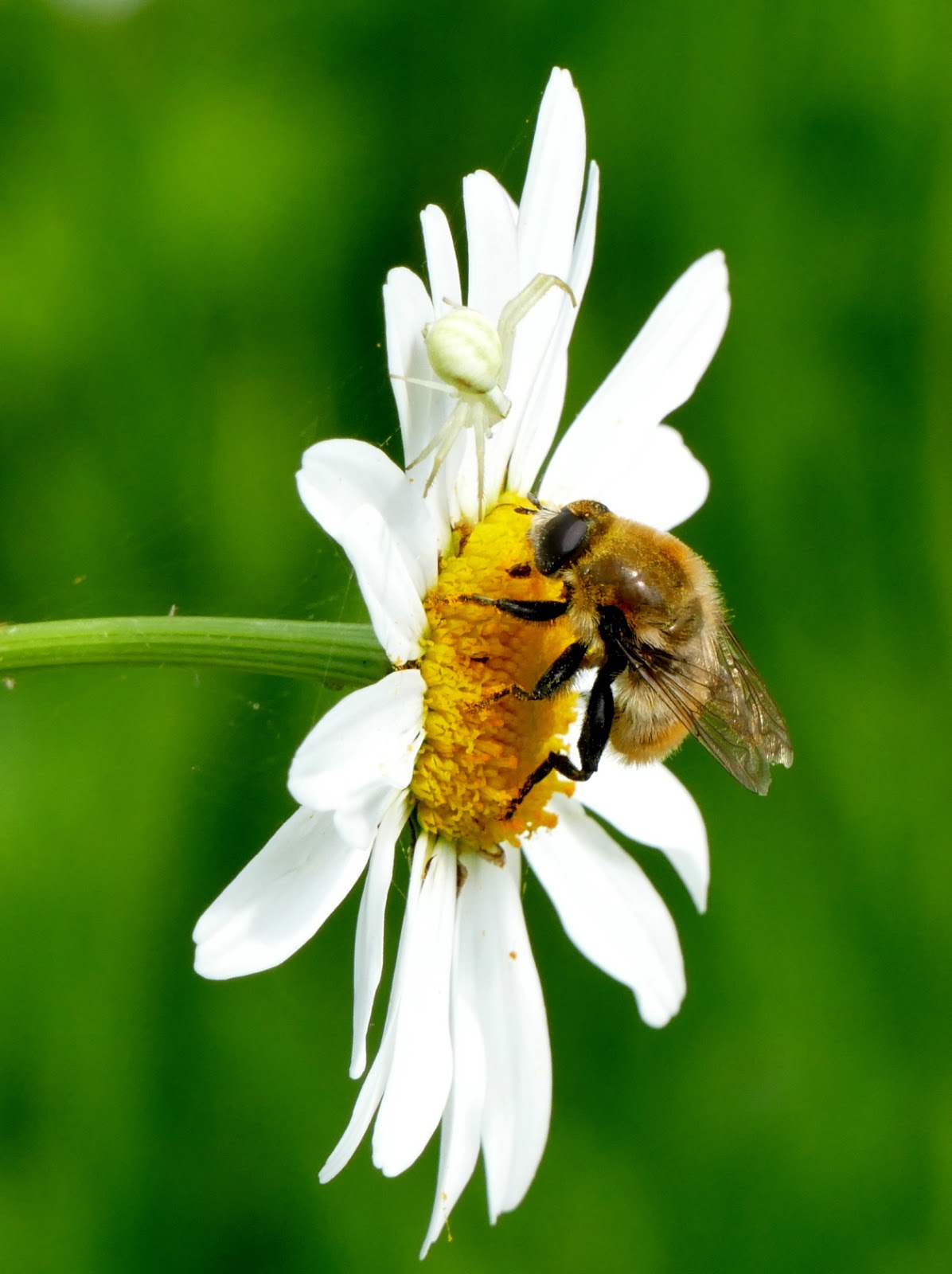
Subterfuge and camouflage in nature: a bee-look-alike fly has a lucky escape

Wild bees are fascinating.  And some hoverflies mimic bees for protection presumably. This bee-look alike fly has a lucky escape though when it is next to a crab spider on an oxeye daisy in my garden.  Crab spiders do not make a web.  Instead they wait on a flower and ambush visiting insects especially butterflies, biting them behind the head and paralysing them with poisonous venom.

Love is blooming on buttercups, or do my manly thighs look fat against this yellow background

Male Fat-legged flower beetle
Fat-legged flower beetles (Oedemera nobilis) are all over the buttercups in my Sussex garden this morning.
Female Oedemera nobilis flower beetle
Only the male has fat "thighs": the female is svelte.
The beetles feed on pollen and characteristically they have narrow, gaping elytra (wing cases).
Their larvae live in the stems of various herbs.  Handsome creatures don't you think?  And another reason to let your lawn bloom with wild flowers.

Bumblebees; Common Carder bee, Forest cuckoo bee and more


male Forest Cuckoo bee, Bombus sylvestris
 In Spring, bumblebee queens emerge from hibernation, build a nest and raise their workers.
Now, at his time of year, in addition to workers, they produce males and new queens for a second generation.  Below is a male Common Carder bee, Bombus pascuorum on Yellow Rattle in my Cuckfield garden in West Sussex yesterday.  Whilst above is a male Forest Cuckoo bee, Bombus sylvestris, which is parasitic on mainly Early bumblebees (see below).
male Common Carder bee, Bombus pascuorum on Yellow Rattle


Buff-tailed bumblebee male, Bombus terrestris
Buff-tailed bumblebee worker, Bombus terrestris

Buff-tailed bumblebee worker, Bombus terrestris
Early Bumblebee worker, Bombus pratorum
Should you know anyone interested in illustrated talks on wild bees, please see my website at http://www.peterlovetttalks.co.uk/page15.html 
Blog Archive